Link a card once. Use it everywhere.
The PayOS Wallet is a PCI-compliant vault for storing and managing cards. Each card is tied to a user identity by phone or email, securely stored, and accessible from any integration channel, for agentic and traditional commerce alike.
Stored cards, without the PCI burden.
PCI-compliant storage
Cards are securely stored in PayOS. Your systems never hold sensitive card data.
User-centric identity
Each wallet is tied to a user by phone or email. One identity, multiple cards.
Multi-card support
Users store and manage multiple cards in a single wallet.
Processor-agnostic
Stored cards can be sent to any processor through Orchestration. No lock-in.
Agentic + traditional
The same wallet powers both AI-driven and standard digital checkout.
Create, add, manage.
Create users
A wallet user is identified by phone or email, no passwords needed. PayOS returns a walletUserId for all later operations, and externalUserId lets you correlate guest checkout before a user exists.
Add cards
Cards enter through any collection channel, PaymentSheet, Card Element or Direct API. Each is securely stored and can be verified at collection time.
Manage cards
View a user’s stored cards and remove ones no longer needed, all through the API or SDK.
Pick your integration depth.
PaymentSheet
Pre-built component that handles card entry, storage and checkout in one flow.
PayOS SDK
Client-side SDK for building custom onboarding and checkout flows.
Full API
Server-to-server endpoints for user creation, card management and payments.
A wallet user is a phone or an email.
No passwords, no custom account systems. Verify a phone or email, and you have an identity.
An identity keyed on phone number or email. One identity, many cards. PayOS returns a unique walletUserId used for every later operation.
Pass your own externalUserId to set up a guest before a PayOS user exists. At checkout, the guest resolves into a wallet user from the verified phone or email, and always maps back to the same one.
What the consumer sees.
PaymentSheet walks a consumer through wallet setup in four steps. A returning user on a trusted device skips the OTP, remembered for 90 days.
Phone verification
An OTP creates or resolves the wallet user.
Add card
Secure card entry in an iframe. It never touches your servers.
Register passkey
Face ID or fingerprint enrollment binds consent to the identity.
Onboarded
Wallet user created, card stored and network-token provisioned.
Onboarding users into the wallet
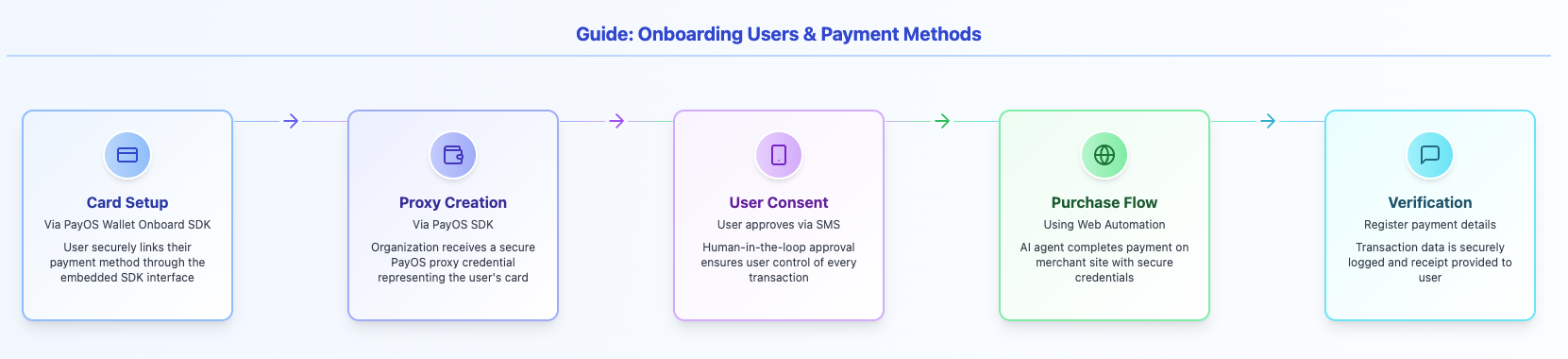
One wallet for agentic and traditional checkout.
Store cards securely, tie them to a user identity, and send them to any processor.